

Food manufacturers everywhere are under pressure to package products faster, more hygienically, and with fewer errors than ever before. A food packaging machine is often the single biggest factor that determines whether a production line can meet that pressure or falls behind it. Whether you’re running a bakery, a snack food plant, or a large-scale confectionery operation, the right packaging equipment affects everything from shelf life to labor costs to how consistently your brand shows up on the shelf.
This guide breaks down the main types of commercial food packaging machines, where automation genuinely pays off, and what to evaluate before investing in new equipment. It’s written for production managers, procurement teams, and factory owners who need practical, real-world guidance rather than sales copy.
What Is a Food Packaging Machine?
A food packaging machine is industrial equipment designed to wrap, seal, fill, or bag food products automatically or semi-automatically, replacing manual packaging steps with consistent, repeatable processes. These machines handle tasks such as measuring product quantities, forming packaging material into bags or pouches, sealing for freshness, and in many cases, labeling and coding in the same cycle.
Depending on the product — solid, liquid, powder, or irregularly shaped items like baked goods or candy — the machine’s design and mechanics will differ significantly. That’s why choosing the right category of equipment matters more than chasing the fastest machine on paper.
Why Manufacturers Are Shifting to Automatic Packaging Machines
Labor shortages, rising wage costs, and stricter food safety expectations have pushed many plants toward automation over the last several years. An automatic packaging machine reduces reliance on manual labor for repetitive tasks, which lowers the risk of contamination from human handling and cuts down on inconsistent seal quality.
Automation also improves traceability. Many modern systems integrate date coding, batch tracking, and weight verification directly into the packaging cycle, which is increasingly important for compliance with food safety regulations across different markets.
That said, automation isn’t automatically the right choice for every operation. Smaller producers with lower, more variable volumes sometimes find semi-automatic equipment more cost-effective, at least until production scales up.
Types of Industrial Packaging Machines Used in Food Production
Not all industrial packaging machines serve the same purpose. Here’s a breakdown of the categories most common in food manufacturing.
Flow Wrap Machines
Flow wrapping is widely used for bars, biscuits, baked goods, and individually wrapped snack items. It forms a continuous film around each product and seals it end to end, offering good speed and a clean, professional finish. You can see a detailed breakdown of this equipment type on our flow packing machine page.
Vertical Form-Fill-Seal (VFFS) Machines
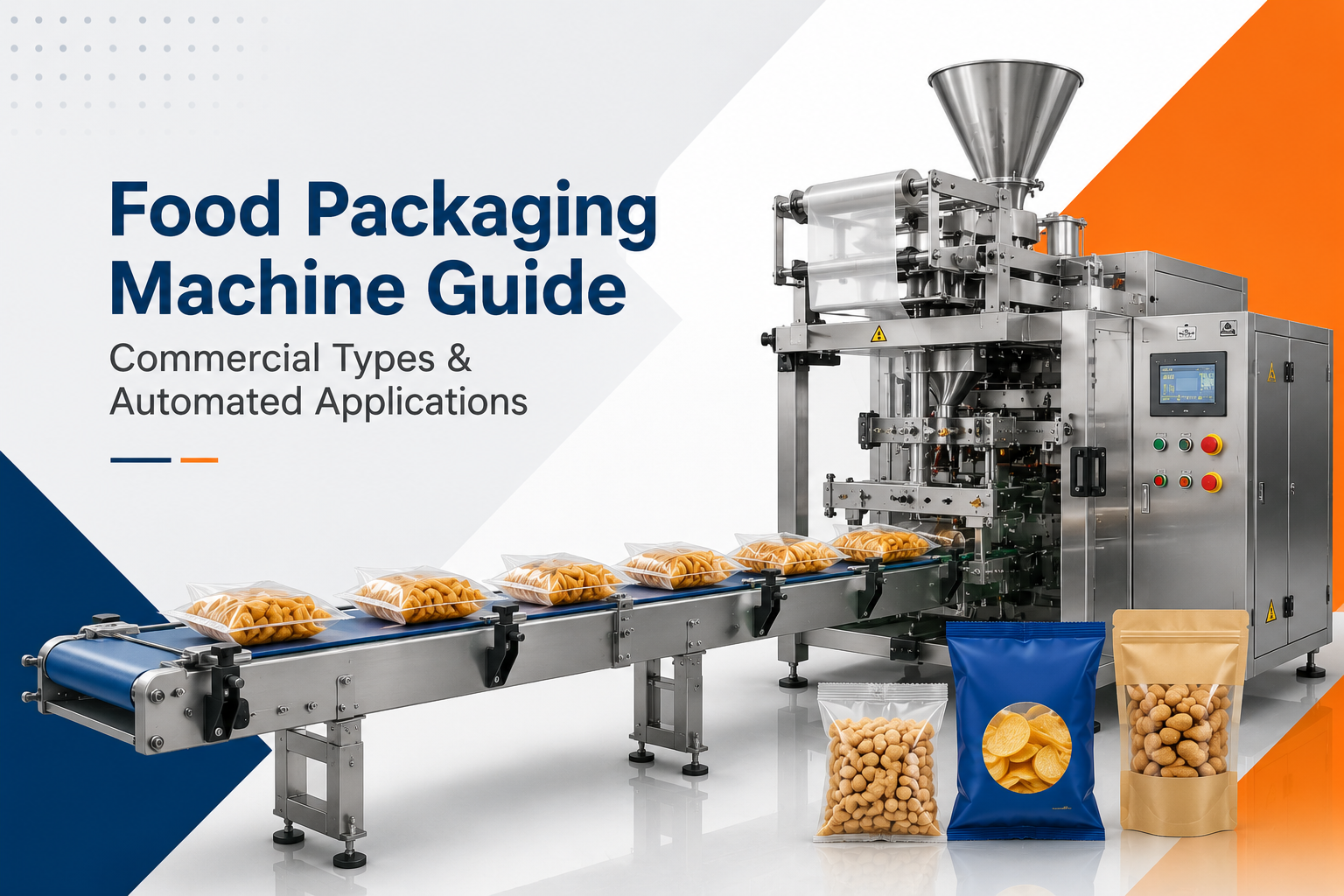
VFFS systems are common for granular or powdered products like sugar, spices, and snack mixes. The machine forms a bag from a roll of film, fills it, and seals it vertically in one continuous motion, making it a strong fit for high-volume operations.
Tray Sealing Machines
Tray sealers are typically used for ready meals, fresh produce, and meat products where a rigid or semi-rigid tray needs a secure, often modified-atmosphere seal to extend shelf life.
Pouch Packing Machines
Stand-up pouches and sachets are increasingly popular for sauces, snacks, and single-serve items. Pouch machines can handle liquids, solids, and semi-solids depending on configuration. For a wider look at general-purpose packaging equipment, our packing machine overview covers several configurations side by side.
Key Features to Look for in a High-Speed Food Packaging Machine
Speed alone shouldn’t drive a purchase decision. A few features matter more in day-to-day operation:
- Changeover time — how quickly the machine switches between product sizes or packaging formats.
- Sanitary design — stainless steel construction and easy-clean surfaces reduce contamination risk and downtime for cleaning.
- Seal integrity monitoring — built-in sensors that flag weak seals before they leave the line.
- Compatibility with packaging materials — not every machine handles recyclable or compostable films equally well, which matters as sustainable packaging demand grows.
- Ease of maintenance — accessible components and clear diagnostics reduce unplanned downtime.
Benefits of Automated Food Packaging Machinery
- Higher throughput without proportionally increasing labor headcount
- More consistent seal quality, reducing product spoilage and returns
- Improved compliance through integrated batch coding and tracking
- Lower long-term labor costs despite higher upfront investment
- Reduced product waste from more precise fill accuracy
- Better workplace safety by minimizing repetitive manual handling
Food Packaging Machine vs Manual Packaging: A Quick Comparison
| Factor | Automated Food Packaging Machine | Manual Packaging |
| Speed | High, consistent output | Limited by worker pace |
| Labor requirement | Low to moderate | High |
| Seal/fill consistency | Very high | Variable |
| Upfront cost | Higher | Lower |
| Long-term operating cost | Lower per unit | Higher per unit |
| Scalability | Strong | Limited |
| Best suited for | Medium to high volume production | Very low volume or highly custom runs |
Factors That Affect Cost and ROI
The price of an industrial packaging machine depends on throughput speed, level of automation, materials handled, and after-sales support such as spare parts availability and technician training. A higher upfront cost often pays back faster than expected once labor savings, reduced waste, and fewer product recalls are factored in — but the payback period varies by production volume, so it’s worth running the numbers against your actual output rather than a generic estimate.
How to Choose the Right Packaging Machine for Your Production Line
Start with your product characteristics — is it solid, liquid, fragile, or irregularly shaped — before looking at machine speed specifications. Match the equipment category to your product first, then narrow down by required output rate, available floor space, and budget. It’s also worth consulting with an equipment specialist or engineer before finalizing a purchase, since factors like film compatibility and line integration aren’t always obvious from a spec sheet alone.
Frequently Asked Questions
- What is the difference between a food packaging machine and a general industrial packaging machine? A food packaging machine is built to meet food-grade hygiene and material standards, while general industrial packaging machines may not require the same sanitary construction or food-safe material compatibility.
- Can an automatic packaging machine handle multiple product types? Many machines can be adjusted for different product sizes and formats, though switching between very different product categories, like powders versus solid bars, usually requires a different machine type.
- How long does it take to see ROI on a high-speed packaging machine? This varies widely based on production volume, labor costs in your region, and the machine’s throughput, so it’s best evaluated case by case with actual production data.
- Is automated packaging suitable for small or growing food businesses? Semi-automatic machines are often a practical middle step for growing operations before moving to fully automated, high-speed lines.
- What maintenance does a food packaging machine typically require? Routine cleaning, sensor calibration, and periodic replacement of seal bars or wear components are standard; maintenance needs depend on machine type and usage intensity.
Conclusion
Choosing the right food packaging machine comes down to understanding your product, your volume, and your growth plans rather than simply picking the fastest or most automated option available. Flow wrappers, VFFS systems, tray sealers, and pouch machines each solve different packaging challenges, and the best choice is the one that fits your actual production line, not a generic industry standard.
If you’re evaluating equipment for your facility, explore our detailed breakdowns of flow packing machines and general packing machine options, or reach out to discuss which configuration fits your production goals.